
 belman@belman.com

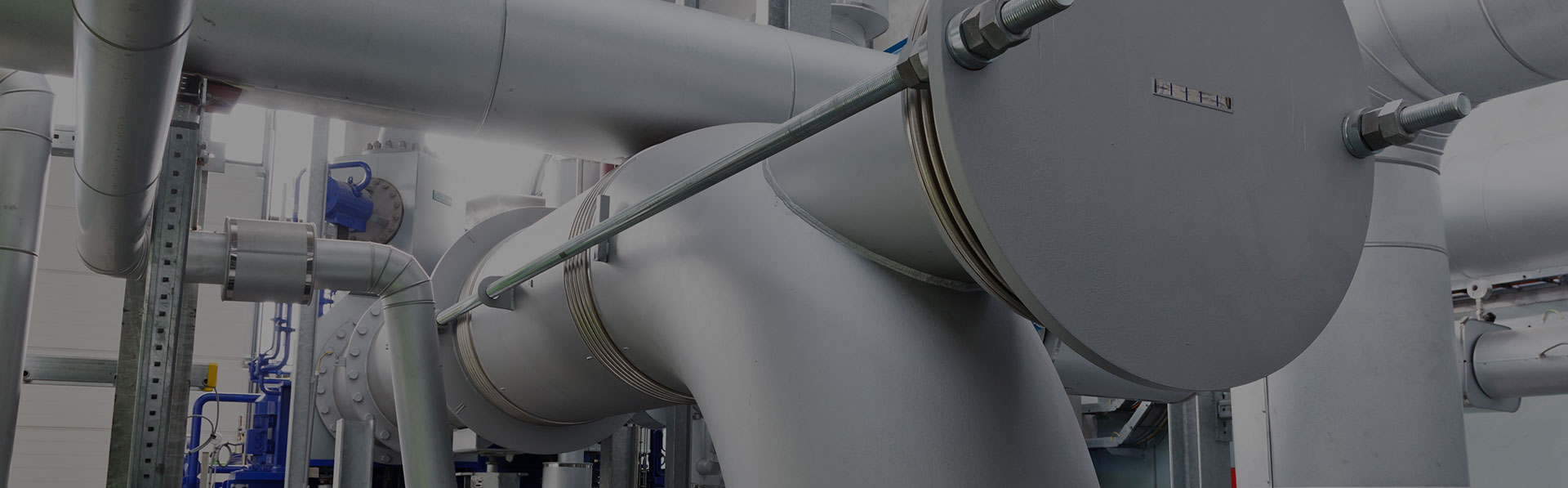

ELBOW PRESSURE BALANCED EXPANSION JOINTS
Elbow Pressure Balanced Expansion Joints or Corner Relief Expansion Joints are the types of Pressure Balanced Expansion Joints, which are used where pressure thrust forces on equipment or piping is unacceptable and the direction of the pipe system also changes. In order to understand the primary advantage of an Elbow Pressure Balanced Expansion Joints, it is important to understand how ordinary Expansion Joints influence the pipe system, in which it is installed.
When a pipe system with an ordinary Axial Expansion Joint installed is pressurised, the pressure reaction force as well as the force needed to move the pipe Expansion Joint is transmitted to the pipe system. The pressure thrust force can be considerable, generating high demands and stresses on the guides and fix points used for supporting/fixing the pipe system.
By installing Elbow Pressure Balanced Expansion Joints, the pressure thrust force is balanced internally within the Expansion Joint and only the spring rate force, which is needed to move the Pipe Expansion Joint is transmitted to the pipe system.
This reduces the load acting on the guides/fix points, which further reduces the need for supporting structures. This enables the use of lighter guides that can deliver significant savings, especially where structural and foundation work is impractical. This feature makes them the preferred choice for pipe systems, where pressure thrust loads acting on flanges and/or connected equipment such as turbines is avoided.
Design range and scope of supply within Elbow Pressure Balanced Expansion Joints
Elbow Pressure Balanced Expansion Joints are available in all sizes and materials.

DIMENSIONS:
DN 15-12.000

PRESSURE:
Up to 150 barg or more if required

TEMPERATURE:
-256°C to +1000°C

MATERIALS:
Austenitic stainless steels, High alloys, Duplex, Titanium, Hastelloy,
Incoloy, Inconel, Alloy 59

DESIGN CODES:
EN 13445, EN 13480, EN 14917
ASME VIII, div.I, ASME B31.3
ASME B31.1, EJMA, AD 2000
and others on request

TESTS:
Radiographic examination (X-ray), Helium leak testing, Pressure test, Air test, Dye penetrant test, Magnetic particle examination and many more


