belman@belman.com


HOT WALL FCC EXPANSION JOINTS
 Oil refinery
 Finland
 EJMA
EJMA
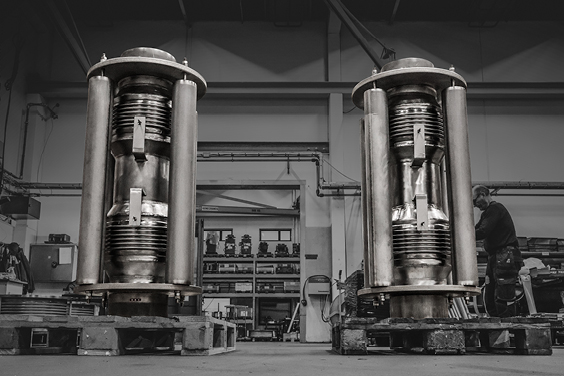
For an oil refinery in Finland, Belman designed and manufactured two Hot Wall FCC Expansion Joints for installation in the critical flow line carrying flue gas, hydrocarbon and catalyst fines. The Expansion Joints served as a 1:1 replacement for existing Expansion Joints.
CLIENT ISSUE
In the flow line at its oil refinery, the client had two Expansion Joints that had reached the end of their service life. As the existing Expansion Joints had performed satisfactorily, the client requested an identical replacement solution. With detailed specifications, requirements and drawings in hand, the client sought an experienced and certified manufacturer capable of designing and manufacturing the required Hot Wall Expansion Joints. One key requirement was that the pressure-bearing steel materials met EN or ASME material standards and were of EU origin.
BELMAN SOLUTION – Hot Wall FCC Expansion Joints
Belman designed a solution based on the client’s specifications and drawings of the existing FCC Expansion Joints. In order to optimise the solution however, Belman proposed a minor modification to the material selection. Due to the high media temperature, thermal impact normally requires that the wall materials be high-temperature-resistant stainless steel. For this reason, the Bellows and inner sleeves were specified in Inconel 625, which is commonly used in FCCU applications for its superior mechanical strength and excellent corrosion resistance across a wide range of temperatures and aggressive environments. Therefore, the client originally specified Inconel 625 for the welding ends as well, in line with the material used in the original Expansion Joints. Nevertheless, Belman suggested using material 1.4878 (AISI 321H) instead – an austenitic, heat-resistant stainless steel. Unlike Inconel, which is nickel-based, AISI 321H provides sufficient corrosion and temperature resistance for this application while offering a more cost-effective solution. This substitution allowed the client to maintain performance standards while reducing material costs. The Bellows and inner sleeves, however, remained in Inconel 625 due to strength calculation requirements.
For corrosion protection, the Expansion Joints were coated with a primer and a silicone-aluminium coating, which was applied in accordance with the client’s specifications for thickness, type and application method.
Insulation that could maintain a low skin temperature
Between the Bellows and the inner sleeves, Superwool insulation was placed to maintain the Bellow’s skin temperature at a sufficiently low level despite the elevated media temperature. The Expansion Joints were designed as tied double Bellow Expansion Joints, allowing them to absorb large lateral movement in both planes – although not simultaneously. To control the movement absorption, tie rods were integrated into the design. As per the client’s requirement to minimise the temperature of the tie rods – ideally not exceeding 50 °C – the tie rods were insulated with Superwool and enclosed in a protective casing. This construction effectively maintained the tie rod surface temperature within the specified limits.
Leak indicators with pressure gauge and valve
A key client requirement was that all Bellows be equipped with leak indicators, consisting of a pressure gauge and valve connected to the space between the Bellows layers. This configuration, known as 2-ply testable Bellows, is designed to provide early detection in the event of a ply failure. Two-ply testable Bellows are constructed from two material plies of equal thickness, with a small interstitial space between them where the leak monitoring system is installed. Each ply is engineered to independently withstand the full design load. This means that if one ply develops a leak or fails, the second ply can continue to maintain pressure integrity and allow safe operation until the next scheduled shutdown. 2-ply testable bellows are widely used in Fluid Catalytic Cracking Units (FCCU/FCC) and other critical applications, such as in chemical plants, where early failure detection and operational reliability are essential.
Quality assurance and quality control of the FCC Expansion Bellows
Due to the critical nature of the application, the Expansion Joints were manufactured with full traceability and CE marked in accordance with Category II of the PED 2014/68/EU, Module G. The conformity assessment was witnessed by both the client and a third-party inspection body. A full Manufacturing Data Book (MDB) was delivered to the client. For the FCC Expansion Joints, the following tests were conducted, among others, as per client request:
- Visual test (VT)
- Tightness test
- Penetrant test (PT)
- Radiographic test (RT)
- Leak test
- Magnetic test
- Pressure test
Belman – acknowledged supplier of customised FCC Expansion Joints
Belman has extensive expertise in engineering and manufacturing Expansion Joints for Fluid Catalytic Cracking Units (FCCUs) and other applications within oil refineries. Over the years Belman has successfully designed and produced customised FCCU Expansion Joints for installation in numerous countries. Among Belman’s notable solutions are a fully customised 30-tonne FCC Expansion Joint with a special manhole as well as three uniquely engineered FCC Expansion Joints delivered in just 12 weeks, demonstrating both our technical capabilities and flexible delivery performance.